Camera & Creator / PRODUCT GUIDE
Canon PowerShot V10: a wide, pocketable camera made to film yourself
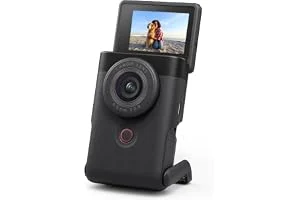
The PowerShot V10 pairs a one-inch sensor and an unusually wide fixed lens with a built-in stand, flip-up screen, and stereo microphones. Here is where that all-in-one layout helps, where the fixed framing gets limiting, and how it compares with Sony’s ZV-1 and Canon’s EOS R100.
As an Amazon Associate I earn from qualifying purchases.
View Canon PowerShot V10 compact vlogging camera on Amazon (paid link) ↗
A camera built around the selfie angle
Canon’s PowerShot V10 is a compact vertical-handgrip camera with a one-inch back-illuminated CMOS sensor and a fixed 19mm-equivalent f/2.8 lens for video. That wide view is useful when the camera is held at arm’s length or placed on a table for a talking-to-camera clip. It can include a person and some surroundings without backing up very far. It is a fixed-lens design, though: there is no optical zoom and no lens mount, so framing relies on moving the camera or using digital zoom.
The flip-up screen and stand change setup
The 2-inch touchscreen tilts upward about 180 degrees so the person filming can check framing. The built-in stand folds out and can tilt the camera forward or back by about 30 degrees, making a tabletop angle possible without carrying a separate mini tripod. It is handy for a cooking demonstration, desk recording, or a quick self-shot. The small screen and vertical body are less comfortable for long menu sessions than a larger camera display.
Built-in sound is a real part of the design
Canon specifies stereo microphones and a third microphone for noise reduction, plus a 3.5mm external microphone input. That means a simple indoor piece can start without another audio accessory, and a wired mic can be added when the subject is farther from the camera. Built-in mics still record the room around the camera; for windy outdoor work, a close mic and appropriate wind protection matter. Confirm the mic’s plug-in power needs before connecting it.
Resolution, orientation, and files
The V10 records UHD 4K up to 30p on the U.S. model and Full HD up to 60p; Canon’s published recording format is MP4 with 8-bit H.264 video. It can switch to vertical framing when turned on its side, which saves a crop-and-reframe step for vertical-first clips. The camera uses one UHS-I microSD card slot, so check that your existing cards meet Canon’s card-speed guidance and plan for a single recording card rather than dual-slot backup.
Stabilization has a framing tradeoff
There is no optical image stabilization in the lens. Canon offers digital movie stabilization, including an Enhanced setting in its current product guidance, but the specification notes that digital stabilization crops the image. That is most noticeable with a wide selfie lens: turning on stronger stabilization can make the composition feel tighter. For a locked-off stand shot, leave digital stabilization off; for handheld movement, test the crop and walking motion before relying on it.
Useful extras and practical limits
Canon lists Wi-Fi and Bluetooth control through Camera Connect, USB Video Class support for compatible devices, and a micro-HDMI output. That gives the V10 more jobs than a one-use travel camera: it can serve as a simple webcam and transfer clips to a phone. It is still optimized around short creator clips, not a flexible still-photo system. The fixed wide lens cannot zoom in on a distant subject, and digital zoom cannot replace a longer lens. Canon also lists a maximum of about one hour per normal recording, with some special 4K smooth-skin recording limited to about five minutes.
PowerShot V10 versus Sony ZV-1
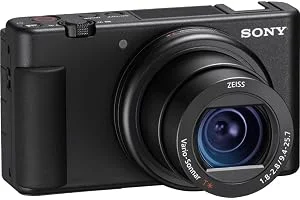
The Sony ZV-1 keeps a compact creator-camera format but changes the shooting choices: its one-inch sensor pairs with an optical 24–70mm-equivalent f/1.8–2.8 zoom, a 3-inch side-flip touchscreen, a microphone jack, and Sony’s directional three-capsule microphone. That is a stronger fit if you want to frame tighter, shoot portraits or product details, and still keep the camera small. The V10 is simpler to stand on a table and starts wider for arm’s-length video; the ZV-1 gives you more control over framing and a larger screen.
PowerShot V10 versus Canon EOS R100
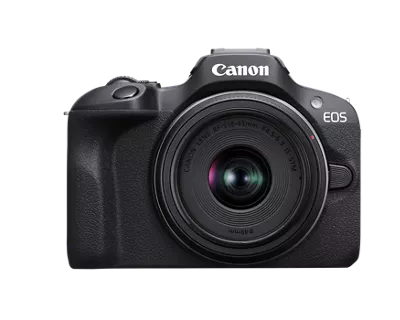
The EOS R100 is the step toward a conventional interchangeable-lens camera: Canon specifies a 24.1-megapixel APS-C sensor, an RF lens mount, an electronic viewfinder, and a 3.5mm microphone input. Its 4K recording is cropped and tops out at 24p, but the kit lens can be changed as your needs grow. Choose the V10 for a small, ready-to-record vlogging camera with a built-in stand; choose the R100 if still photography, looking through a viewfinder, and swapping lenses matter more than an ultra-compact body.
Who should buy this creator camera
The V10 makes sense for a beginner or creator who mostly records direct-to-camera clips, tutorials, or quick vertical videos and wants the camera, stand, and basic audio in one pocketable unit. Skip it if you need optical zoom, an interchangeable lens, a viewfinder, stronger stabilization without a crop, or extensive 4K slow motion. Canon’s specifications establish the features described here; Ryan has not said he owns or tested this particular camera.
Compare the shopping options
Sony ZV-1 compact vlog camera — compare optical zoom and a 3-inch side-flip screen
Canon EOS R100 with 18–45mm kit lens — compare an APS-C interchangeable-lens camera
Sources and review basis
Researched November 18, 2026. Ryan’s own experience is attributed where supplied. Other judgments are buying advice based on the cited product information, not a hands-on comparison or laboratory test. Prices and availability are checked at the retailer.
- Canon U.S.A. PowerShot V10 specifications: sensor, lens, video, audio, card, stabilization, recording limits and screen
- Canon U.S.A. PowerShot V10 creator features: stand angle, microphone layout, vertical orientation and USB webcam support
- Sony U.S.A. ZV-1 official camera overview and comparison features
- Sony ZV-1 official specifications
- Canon U.S.A. EOS R100 kit: APS-C body and interchangeable RF-S lens kit
- Canon EOS R100 official specifications: APS-C sensor, recording modes and mic input
- Dated Amazon camcorder category snapshot identifying the exact PowerShot V10 listing