Music & Instruments / PRODUCT GUIDE
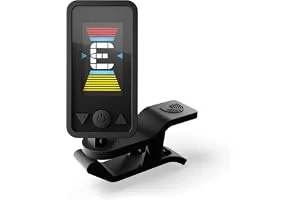
Fender FCT-2 tuner: five instrument modes and a screen you can position
The Fender FCT-2 B074KGZ9Z7 is a clip-on tuner for a player who wants pitch information on the instrument itself. Its useful combination is a vibration sensor, five tuning modes and a dual-hinged color display. The important buying decision is whether that simple headstock setup fits your instruments and tuning reference.
As an Amazon Associate I earn from qualifying purchases.

Position the display before judging the tuner
Fender documents a dual-hinge mount that permits positioning on either side of the headstock. That matters when you want to glance at the display while seated in your normal playing position. Attach it where the clamp sits securely, then arrange the screen so you can see the note and needle without twisting the instrument toward you. This is a practical setup advantage rather than a claim that its screen is brighter than competing tuners. Ryan has not compared sunlight visibility or clamp durability in hands-on testing.
Choose the mode for the notes you intend to play
The FCT-2 offers guitar, bass, violin, ukulele and chromatic modes. The named instrument modes are convenient starting points for ordinary tuning; chromatic mode is the useful option to investigate when working with notes outside a standard string sequence. Write down the target notes for an unfamiliar alternate tuning before turning the pegs. A centered needle only helps when the displayed note is the note you actually want. Work one string at a time and damp the others so the display has a clearer signal to follow.
Understand what the vibration sensor contributes
The built-in sensor reads vibration through the attached instrument rather than requiring a cable from a pickup. That makes the format worth considering for an acoustic instrument or a lesson where plugging into a pedal is unnecessary. It also keeps your phone available for a chord chart or backing track. Those are workflow advantages, not proof that the FCT-2 is immune to every noisy room or vibrating stage. If its reading is unstable, begin by checking the attachment and isolating the string being tuned before making large tuning adjustments.
Check the reference pitch and battery arrangement
Guitar Center lists a B0–B7 tuning range, an A4 reference of 440 Hz and a single 3V CR2032 battery, with one battery included. Buy around that documented A440 specification rather than assuming it supports an adjustable reference for every ensemble. The replaceable coin-cell arrangement also means there is no charging cable to share with your other gear. For a travel kit, check the battery before leaving and know how to replace it. A tuner is useful only when its power arrangement fits the way you maintain small accessories.
Compare D’Addario Eclipse when reference adjustment matters
The cataloged black Eclipse B01IBI88R4 belongs to the PW-CT-17 family, whose manufacturer documents calibration from 430 to 450 Hz. Its vertical full-color display and multi-swivel mount provide another approach to seeing the reading from a playing position. The adjustable reference is the meaningful reason to compare it when an ensemble uses a reference other than A440. It is not evidence that the Eclipse is more accurate. Be sure to select this coin-cell model rather than transferring features from the separately sold rechargeable Eclipse.
Compare Snark SN5X by display shape and positioning
The Snark SN5X B01H74YV56 is a fully chromatic vibration-sensing tuner with a round display that rotates through 360 degrees. It is a relevant alternative if that display and mounting arrangement look easier to accommodate on your instrument. The Fender offers the explicit five-mode selection described above; the Snark comparison is about a different control and display format, not a tested speed advantage. Look at the position where you would actually mount either one. If your current tuner already provides a clear, stable reading there, a new shape alone may not justify replacing it.
Compare the shopping options
D’Addario Eclipse — adjustable 430–450 Hz reference
Snark SN5X — round, rotating chromatic display

Sources and review basis
Researched November 21, 2026. Ryan’s own experience is attributed where supplied. Other judgments are buying advice based on the cited product information, not a hands-on comparison or laboratory test. Prices and availability are checked at the retailer.