Toys, Games & Building Sets / PRODUCT GUIDE
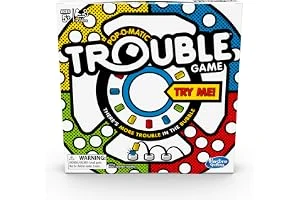
Hasbro Trouble: a family race game for players who enjoy a setback
How the Pop-O-Matic game fits family game night, what to check in the rules, and how it differs from Connect 4.
As an Amazon Associate I earn from qualifying purchases.
View Hasbro Trouble board game on Amazon (paid link) ↗
Buy for the group’s temperament
Trouble is worth considering when the fun comes from a shared race and unexpected reversals. It is less compelling if your group wants a game where careful planning reliably decides the winner. Before choosing it as a gift, think about how the players react when progress disappears. Laughing at a setback is part of the appeal for some families; for others, it is exactly what ends a game early. Ryan has not supplied a personal review of this game.
What the A5064 game actually includes
Hasbro identifies this version as A5064: a board and plastic game unit with the enclosed Pop-O-Matic die roller, 16 pegs, four rubber feet and instructions. It supports two to four players and requires adult assembly. The manufacturer lists ages five and up for this model. The small pieces make it unsuitable for children under three. The bubble contains the die, but it does not contain the loose playing pegs.
Understand the race before teaching it
Each player works to bring four pegs around the board and into the finish. An opponent landing on your peg sends it back to start over. That creates a useful buying distinction: this is direct interaction, not four people quietly building separate scores. As an editorial suggestion, explain the possibility of being sent back before the first turn. Discovering that rule only after a child has made progress can feel different from knowingly joining a chase game.
Check the rules for the edition you own
Do not assume every rule remembered from childhood applies to the box in front of you. Hasbro’s A5064 clarification says that rolling a one leaves the roller unable to move while other players may bring a peg from home to start; an occupied start blocks bringing out another. Manufacturer pages also describe editions with special board spaces. Keep the supplied rule sheet with the game and use its matching product number when replacing missing instructions.
Where it fits on a family evening
The attraction is a visible board state and a physical action everyone can follow. It can be a shared-table choice when you want more interaction than a solo puzzle. The limitation is that a player waiting for a favorable roll may feel less involved than someone choosing between several moves. Rather than promising a fixed play time, leave room for a full game and choose another activity when you must stop at an exact minute.
Compare Connect 4 for a two-person contest
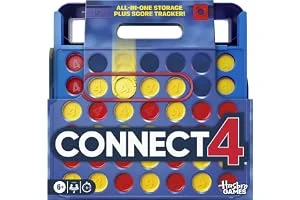
Connect 4 makes more sense when exactly two people want a head-to-head placement game. Its goal is four discs in a row, so the conversation shifts toward spotting threats and blocking a line rather than responding to a die. The 2025 catalog edition adds integrated storage and score tracking. Trouble accommodates up to four at once; Connect 4 requires rotating players if more people want to join. Choose the group size and style first, then compare the boxes.
Compare Jenga for physical suspense
Jenga is another option when your group likes watching a tense moment unfold but does not want a racing board. The decision becomes which block to remove and how carefully to move it, rather than which peg to advance. A steady play surface matters for the tower. Trouble is the better shortlist candidate for people who specifically want a board race; Jenga is the more relevant alternative when careful hand movements are the entertainment.
A useful gift check before ordering
Confirm A5064 and the pictured board against the selected listing, especially when browsing themed or travel editions nearby. Ask whether the household already owns a working copy; a fresh theme is not necessarily a new experience. Consider who will explain the rules and store the pegs. This is a practical family-game option for the right group, not a claim that every child of the suggested age will enjoy competitive setbacks.
Compare the shopping options
Connect 4 (2025) — two-player placement game
Jenga Classic — compare physical suspense

Sources and review basis
Researched November 18, 2026. Ryan’s own experience is attributed where supplied. Other judgments are buying advice based on the cited product information, not a hands-on comparison or laboratory test. Prices and availability are checked at the retailer.