Toys, Games & Building Sets / PRODUCT GUIDE
Rubik’s Original 3×3: a stickerless classic with a real learning curve
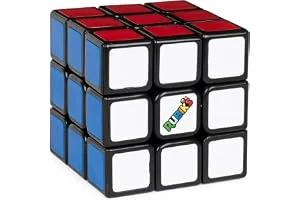
This current Original 3×3, Spin Master model 6063971, uses colored plastic tiles and a revised turning mechanism rather than peelable stickers. It is a portable one-cube logic puzzle for ages eight and up, but the standard mechanism is not marketed as a magnetic competition speed cube and solving it usually requires learning a method rather than guessing.
As an Amazon Associate I earn from qualifying purchases.
View Rubik’s Original 3×3 Cube on Amazon (paid link) ↗
Confirm model 6063971 and one cube
ASIN B092W7D64G identifies the current Original Rubik’s 3×3, Spin Master model 6063971, with one cube in the box. Rubik’s sells mini, 2×2, 4×4, connected and speed-cube variants with similar colors. Check the model and 3×3 grid before ordering, especially when a marketplace page groups multiple sizes.
The goal is six solid-color faces
Each of the six faces has nine colored tiles. Scramble the layers, then rotate them until every face returns to one color. Center pieces determine the face colors, while edge and corner pieces move around them. That structure makes the puzzle learnable; random twisting can occasionally improve a section but is not an efficient repeatable solving method.
Stickerless tiles remove one familiar maintenance problem
The current official product replaces traditional stickers with embedded colored plastic tiles, so edges cannot peel or fade in the same way as paper labels. The plastic can still scratch, discolor or collect dirt, and prying pieces apart can damage the mechanism. Store the cube away from heat and grit and clean only according to the maker’s instructions.
The revised mechanism is smoother, not competition-tuned
Rubik’s describes this generation as smoother, faster and more reliable than older Original cubes. That does not establish magnets, adjustable tension, corner-cutting performance or official speed-cubing preference. A dedicated speed cube is the relevant purchase when timed solves and tuning matter; this model is the straightforward branded classic for learning and casual use.
A first solution is easier with the official method
Rubik’s publishes an eight-step solve guide that teaches piece types and layer-by-layer progress. Following a guide is not cheating; it turns the cube into a sequence of repeatable patterns. Learn notation slowly, practice one stage until it is reliable and keep the cube orientation consistent. A child or adult who dislikes memorized sequences may prefer a puzzle with independent challenge cards.
The manufacturer recommends ages eight and up
The exact model record lists a recommended age of eight years and older. Ability varies, and younger users may enjoy turning or color matching with help, but frustration and small components still matter. Follow the current package warning, supervise as appropriate and do not give a damaged cube with loose pieces to a child who mouths objects.
It is portable but not silent
A single cube fits easily in a backpack or desk drawer and needs no batteries, app or loose cards. Repeated turns make clicking and rubbing sounds that can distract people in a quiet classroom, meeting or flight. Use it where hand movement and noise are welcome rather than treating “fidget” marketing as permission in every setting.
One puzzle can support solo or social play
The basic challenge is solitary, but families can scramble for one another, compare solve stages or take turns following the guide. Timed competition adds pressure that some learners enjoy and others do not. Avoid presenting speed as the only success measure; completing a face, learning notation or solving with fewer prompts are meaningful milestones.
Do not force a jammed layer
Layers should align before a turn. If a piece catches, return the layer gently to square and check for grit or misalignment instead of twisting harder. The companion manual notes that a stiff mechanism can loosen with normal repeated use. Avoid household oil or unapproved lubricant, which can attack plastic and trap debris.
Compare Kanoodle Fan Edition for card-based solo puzzles
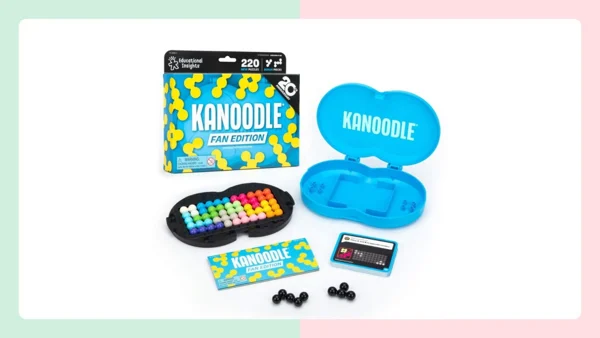
The cataloged Kanoodle Fan Edition uses twelve pieces and 220 two- and three-dimensional challenges in a portable case. Each card provides a defined starting arrangement, so progress is broken into many short problems rather than one algorithmic cube. Choose Kanoodle when graded challenges and a case appeal more than learning twist sequences.
Compare Jenga for a multiplayer physical challenge
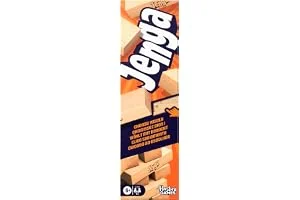
The cataloged Jenga Classic uses 54 wooden blocks and asks players to remove and stack pieces without toppling the tower. It is easier to explain to a group and creates visible suspense, but it needs a stable table, setup space and all the blocks. Choose Rubik’s for compact solo practice and Jenga for shared hand-skill play.
The buying call
Choose the Original 3×3 when you want the current stickerless branded classic and are willing to learn a repeatable solving method. Choose Kanoodle for many card-defined solo challenges or Jenga for group play. Ryan has not claimed to own or solve this exact model; this guide uses Rubik’s and Spin Master documentation and does not invent speed, stress-relief or learning outcomes.
Compare the shopping options
Kanoodle Fan Edition — 220 card-defined 2D and 3D solo challenges
Jenga Classic — 54-block multiplayer stacking challenge
Sources and review basis
Researched November 20, 2026. Ryan’s own experience is attributed where supplied. Other judgments are buying advice based on the cited product information, not a hands-on comparison or laboratory test. Prices and availability are checked at the retailer.
- Rubik’s official Original 3×3 product page and stickerless mechanism description
- Spin Master official model 6063971 contents and product description
- Rubik’s official eight-step 3×3 solve guide
- Exact ASIN B092W7D64G model, age and care record
- Amazon listing for Rubik’s Original 3×3, ASIN B092W7D64G (paid link)
- Educational Insights official Kanoodle family information
- Amazon listing for Kanoodle Fan Edition, ASIN B0GJ1BPKD1 (paid link)
- Hasbro official Jenga Classic instructions
- Amazon listing for Jenga Classic, ASIN B0D87PKYYK (paid link)