Camera & Creator / PRODUCT GUIDE
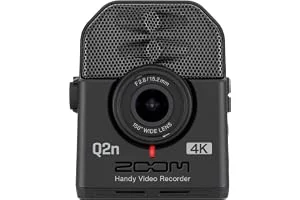
Zoom Q2n-4K: a rehearsal camera that treats audio as the main event
The Q2n-4K pairs a 150-degree fixed lens with a 120-degree XY stereo microphone and can record 4K up to 30p or 1080p up to 60p. It is unusually well suited to documenting a band from one fixed position, but its tiny screen, fixed-focus ultra-wide view and short 4K battery life make it a specialized music recorder rather than a general-purpose vlogging camera.
As an Amazon Associate I earn from qualifying purchases.
View Zoom Q2n-4K video recorder on Amazon (paid link) ↗
Confirm the Q2n-4K rather than the older Q2n
ASIN B07K114TFB is the Zoom Q2n-4K Handy Video Recorder. Zoom also sold an earlier Q2n model with a similar upright body, so confirm the “4K” marking and exact model on the live offer. The Q2n-4K box includes the recorder, lens hood, lens cap and quick guide; a memory card, AA batteries, power adapter and mounts may be separate.
The 150-degree lens favors the whole room
The fixed f/2.8 lens covers an extremely wide 150-degree field of view, with five digital field-of-view settings. That makes it practical to frame a full band from a short distance or capture a small rehearsal room. It does not provide optical zoom or the subject separation of a larger-sensor camera. Place performers away from the extreme edges when facial stretching matters.
Resolution tops out at 4K30, while 1080p reaches 60p
Zoom lists 4K recording at 24, 25 or 30 fps and 1080 recording up to 60 fps. Choose 4K when extra detail and reframing room matter; choose 1080p60 when smoother movement or longer battery life matters. Files are H.264 MOV, not modern 10-bit log footage. The Flat scene preset is useful for modest grading, but it is not a substitute for high-dynamic-range cinema capture.
The XY microphone is the reason to consider it
A fixed 120-degree XY stereo microphone records up to 120 dB SPL, which is designed to handle loud rehearsals and concerts better than a typical phone microphone. Input gain, low-cut options and concert, solo and meeting auto-gain modes help match the source. Loudness handling does not guarantee a clean recording: monitor levels and avoid placing the recorder in a boomy corner or directly against a speaker cabinet.
The 3.5 mm input expands the audio path
The stereo mini input accepts a line or microphone signal and supports 2.5 V plug-in power. That can feed a small external microphone or an appropriate mixer output, while the combined headphone/line output supports monitoring. Confirm signal level and cabling before a show; a mixer’s balanced professional output may require attenuation or conversion rather than a simple adapter.
Storage specifications changed with later firmware
Zoom’s original specification sheet lists microSDXC cards up to 256 GB, while the current product page says supported microSDXC recording can extend to 1 TB as a single file. Treat the current compatibility list and installed firmware as authoritative for a specific card. Format approved media in the recorder and run a full-duration test before relying on it for a performance.
Two AA batteries are convenient but 4K drains them quickly
The recorder uses two AA batteries or USB bus power. Zoom estimates only about 30 minutes of 4K30 recording on alkaline cells, about one hour on Ni-MH cells and about two hours on lithium cells under its test conditions. For a long rehearsal, use proven rechargeable cells or stable USB power, and still keep fresh batteries available so a loose cable does not end the recording.
Webcam mode is convenient but limited
The Q2n-4K can act as a UVC/UAC webcam and USB microphone, but Zoom lists webcam video at 720p with 48 kHz/16-bit audio rather than the recorder’s full 4K quality. That is useful for lessons, remote rehearsals and a wide room view. It uses micro-USB rather than USB-C, and the mounting, power and cable path should be secured before a live session.
Compare the Canon PowerShot V10 for solo presentation
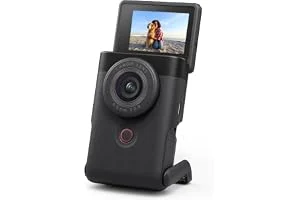
The cataloged Canon PowerShot V10 uses a one-inch sensor, 19 mm-equivalent fixed lens, flip-up screen and built-in stand. It is designed around a presenter facing the camera and supports 4K plus a 3.5 mm microphone input. Its stereo audio is less purpose-built for loud ensemble capture, while its larger sensor, framing screen and face-oriented workflow make it the stronger compact choice for tabletop or walk-up vlogging.
Compare the Sony ZV-1 for autofocus and optical zoom
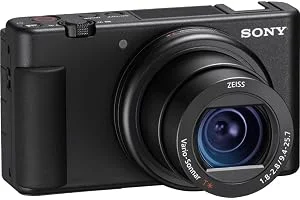
The cataloged Sony ZV-1 has a one-inch 20.1 MP sensor, 24–70 mm-equivalent f/1.8–2.8 zoom, phase-detection autofocus, optical stabilization and a fully articulated screen. It is far more flexible for a moving presenter or mixed photo/video use, but it costs more, sees much less of a small room and lacks the Zoom recorder’s fixed high-SPL XY stereo array. Choose based on whether picture control or room sound is the priority.
The buying call
Choose the Q2n-4K when the job is to park one compact camera in front of a rehearsal, lesson or performance and capture a wide frame with credible stereo sound. Choose Canon V10 for a fixed-lens solo creator workflow or Sony ZV-1 for autofocus and optical zoom. Ryan has not claimed to own or test this exact recorder; this guide is based on Zoom, Canon and Sony documentation.
Compare the shopping options
Canon PowerShot V10 — one-inch-sensor fixed-lens camera with a built-in stand
Sony ZV-1 — one-inch compact with autofocus and a 24–70 mm-equivalent zoom
Sources and review basis
Researched November 19, 2026. Ryan’s own experience is attributed where supplied. Other judgments are buying advice based on the cited product information, not a hands-on comparison or laboratory test. Prices and availability are checked at the retailer.
- Zoom official Q2n-4K product page with lens, storage, audio and box contents
- Zoom official Q2n-4K specification sheet with recording modes, microphone, ports, power and dimensions
- Zoom official support page with firmware, manuals and approved memory-card resources
- Amazon listing for Zoom Q2n-4K, ASIN B07K114TFB (paid link)
- Canon official PowerShot V10 specifications
- Amazon listing for Canon PowerShot V10, ASIN B0C5497S98 (paid link)
- Sony official ZV-1 specifications
- Amazon listing for Sony ZV-1, ASIN B08965JV8D (paid link)